What Venture Institute Is Really Like Behind the Scenes and How to Prepare If You Want to Break Into VC
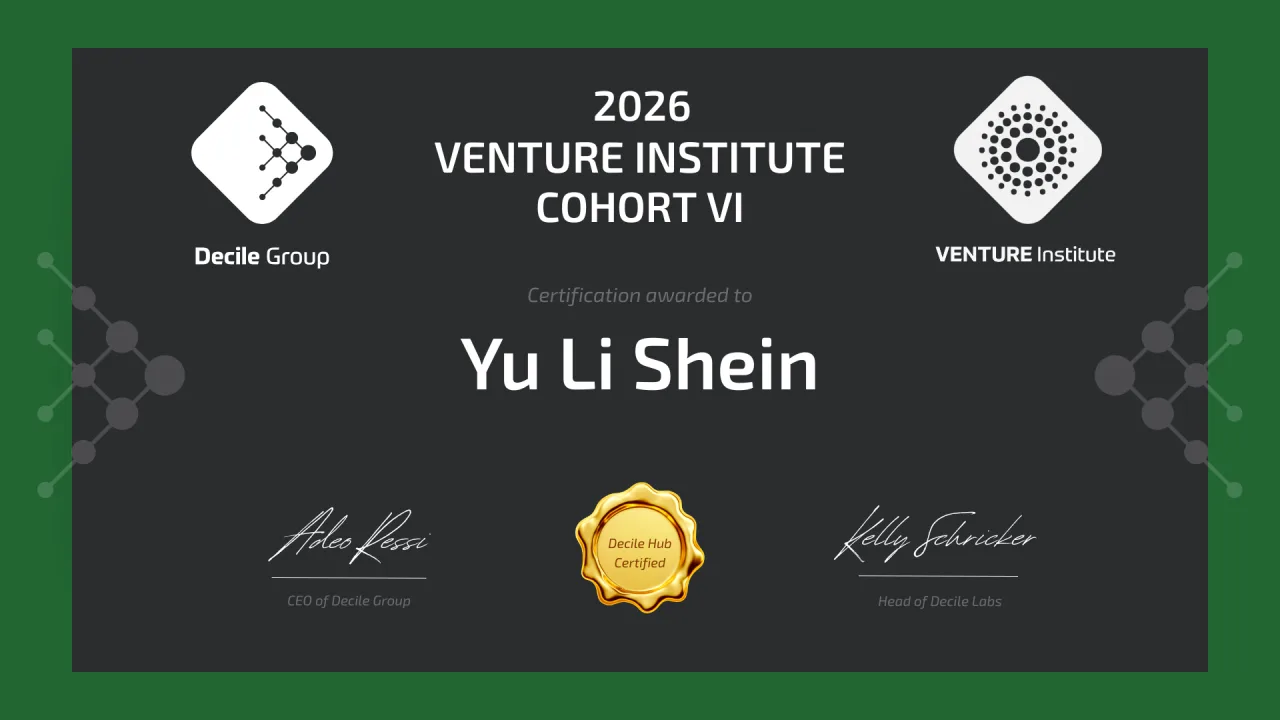
I officially graduated from Venture Institute Cohort 6 by VC Lab / Decile Group.
On paper, that means I completed one of the most selective and rigorous venture capital programs out there.
But this blog is not really about the certificate.
It is about what the experience was actually like behind the scenes.
Because if you are thinking about joining a program like Venture Institute, or if you are trying to move into venture capital from a non-traditional path, what matters most is not the headline. It is the reality behind it.
And the reality is this:
It is intense. It is demanding. It is global. It is full of highly capable people. And it rewards consistency, contribution, and seriousness far more than image.
I wanted to write this not as a generic graduation post, but as an honest reflection for people who may be considering the program in the future, or who are trying to understand what it really takes to move closer to a venture.
1. The Numbers Tell One Part of the Story
The rough breakdown for Cohort 6 looked like this:
- 2,700+ applications
- 489 admitted participants
- 227 remained after the first review
- 195 graduated
- Participants came from around 70 countries
That means the people who finished were roughly in the top 7% of applicants.
Those numbers matter, not because selectivity alone makes something valuable, but because they signal the kind of environment you are entering.
This is not a casual learning experience.
It is a high-bar environment where many strong people begin, but not everyone makes it through.
And that is part of what makes it meaningful.
2. My Time Zone Reality: Japan, 1 AM to 5 AM Sessions, and 3 AM Wake-Ups
One part of the experience that shaped everything for me was geography.
I joined from Japan.
That meant many live sessions happened between 1 AM and 5 AM in my time zone. Most weeks, I was waking up around 3 AM to attend sessions live, engage with the cohort, join discussions, and stay present in the experience as much as possible.
This may sound like a small logistical detail, but it changes the entire feel of the program.
When you are joining a venture session half asleep in the middle of the night, you cannot rely on motivation alone. You need discipline. You need intention. You need to decide in advance that you are going to show up consistently, even when the timing is inconvenient, the workload is heavy, and life is already full.
I did not just attend the main sessions. I also showed up for bonus sessions and other relevant events whenever I could.
That consistency mattered.
Not because someone was counting attendance in a superficial way, but because the value of a program like this is deeply tied to what you put into it.
Showing up live helped me learn faster, build stronger relationships, and understand the people in the room beyond their LinkedIn profiles.
3. What Surprised Me Most: The Quality and Generosity of the People
One of the biggest things I will remember is not just the content.
It is the people.
The cohort was incredibly diverse. Founders, operators, angel investors, aspiring fund managers, ecosystem builders, people with technical backgrounds, finance backgrounds, startup backgrounds, consulting backgrounds, and many more. Different countries. Different stages of life. Different professional histories. Different reasons for joining.
But what stood out to me was not just diversity.
It was generosity.
The strongest people in the program were not simply trying to outperform everyone else.
They were showing up, doing the work seriously, and then helping others.
That was one of the clearest patterns I noticed.
The people who stood out were often the people who:
- completed deliverables early
- understood the material deeply enough to apply it
- asked thoughtful questions
- stayed engaged beyond the minimum
- and were ready to help peers when someone got stuck
In other words, they were not just consuming the program. They were contributing to the quality of the environment.
That is a very important difference.
A lot of people assume high-performing cohorts become competitive in a negative sense. But in my experience, the people who rise in a serious venture environment are often the ones who combine competence with generosity.
They are serious about their own progress, but they are also willing to support others.
That creates a much better culture.
What Actually Makes People Stand Out in the Program
If I had to summarize one of my biggest behind-the-scenes takeaways, it would be this:
The people who stand out are not just the smartest or the loudest. They are the ones who consistently show up, contribute, and make themselves useful.
That showed up in many forms.
Some people were active in the group chat and always ready to answer questions.
Some jumped on Zoom calls to walk others through confusing parts of the sprint.
Some wrote summaries.
Some shared resources.
Some asked excellent questions that made the whole group sharper.
Some hosted side conversations and built real relationships beyond the formal program structure.
Some created thoughtful content that reflected the learning and expanded the conversation publicly.
All of these are signals.
And they matter.
In venture, people often talk about pattern recognition. In programs like this, you begin to notice another kind of pattern too:
The people who create real momentum around themselves are usually not waiting passively for value. They are actively creating it — for themselves and for others.
The Hidden Lesson: This Is Not Just a Course. It Is a Community
One mistake someone could make is treating Venture Institute like an online class.
It is not just that.
Yes, there is content. Yes, there are frameworks. Yes, there are sprints and deliverables.
But the real value comes from treating it like a community and an ecosystem.
That means:
- engaging with peers
- Following up outside the main sessions
- building smaller circles
- getting to know people one-on-one
- and participating in real conversations beyond the formal program calendar
Some of the most meaningful values come from the relationships.
Not transactional networking, but genuine relationship-building.
You begin to understand who thinks well, who executes well, who supports others well, who has strong judgment, who has founder empathy, who has ecosystem access, and who you may want to stay connected with for years.
That kind of network compounds.
And because the cohort is so globally distributed, it also expands your view of what a venture looks like in different markets and different contexts.
My Constraint: I Couldn't Play the Same Game as Everyone Else
One thing I had to accept early on was that I could not contribute in the exact same way as everyone else.
Because I was joining from Japan, much of the real-time interaction in WhatsApp and spontaneous peer coordination naturally favored U.S. and Europe-friendly time zones. Even if I wanted to be as active in those channels, it was simply harder when so much of the conversation happened in the middle of the night or early morning for me.
That was a real disadvantage.
But it also forced me to be more intentional.
If I could not always be the most active person in the chat, then I needed to find another way to create value, become visible, and build stronger connections within the ecosystem.
So I focused on a different strategy: showing up live consistently despite the hour, engaging meaningfully during sessions, following up directly with people, creating thoughtful public content, and building relationships outside the formal structure of the program.
Most importantly, I took initiative to create my own adjacent programming.
During the program, I hosted three webinar / podcast conversations with speakers from the broader Venture Institute / VC Lab ecosystem:
- Breaking Into Venture Capital Without Prior Experience with Sarah Romanko
- Breaking Into Venture Capital Without Prior Experience with Connor Sattely
- Launching Your First Fund from Scratch with Jorden Woods and Radhika Iyengar
For me, this was one of the most important moves I made during the program.
It allowed me to turn my constraint into an advantage.
Rather than only participating inside the existing structure, I created additional surface area for learning, relationship-building, and visibility — not just for myself, but for others who were also trying to understand how to break into venture or build in the ecosystem.
I believe this helped me stand out more than almost anything else.
It showed initiative. It strengthened real relationships. It created useful content. And it made my contribution visible in a way that fit my strengths.
That lesson will stay with me well beyond the program:
You do not have to contribute in the same way as everyone else. But you do need to create value in a way that is visible, useful, and consistent.
My Public Content Strategy Actually Helped
One thing that became clearer to me during the program is that thoughtful content creation can be a real strategic asset when you are trying to move into venture.
I was already active, but being in Venture Institute gave me more clarity around how public signals work.
By consistently writing, resharing, hosting conversations, and engaging around venture topics, I was not just documenting my learning. I was also making my interests, seriousness, and network more visible.
That matters.
Because when you are trying to enter VC from a non-traditional path, your digital presence can do a lot of invisible work:
- it warms up outreach
- it builds familiarity
- it creates credibility over time
- it helps the right people notice you
- and it gives others a reason to understand how you think
I also noticed that this approach paid off in terms of relevance. My followers and audience became increasingly aligned with the direction I want to grow in.
That is not a small thing.
A more relevant audience means better conversations, stronger signal quality, and a more natural long-term path into venture.
What the Program Reinforced About Breaking Into VC
One of my biggest reflections from this experience is that too many people ask the wrong first question.
They ask:
"How do I get into VC?"
But a better question is:
"How do I become valuable enough that venture becomes a natural next step?"
That shift matters.
Because if you approach venture only as a title to get, you will often focus on tactics too early.
But if you approach it as a role you need to grow into, then your preparation becomes much smarter.
You start asking:
- What kind of founder relationships am I building?
- What niche or expertise do I actually have?
- What evidence exists that I can help startups?
- What ecosystem do I have access to?
- How visible is my work and thinking?
- What do people trust me for?
That is a much stronger foundation.
What I Think Future Applicants Should Build in Advance
If you want to move into venture capital from scratch, preparing early makes a huge difference.
Before you apply — whether to Venture Institute or any other opportunity in venture — I think it helps to build several things in advance.
1. Strong founder relationships
Real trust with founders can become a real advantage later.
If founders trust you, talk openly with you, and see you as useful, that can compound into better insight, better deal flow, and stronger ecosystem positioning.
2. A focused niche or area of expertise
You do not need to know everything.
But it helps a lot to know something deeply:
- a geography
- a vertical
- a founder type
- a stage
- a market
- or a type of company
The more specific your expertise, the easier it is to create real value.
3. Proof that you can help founders
Can you make introductions? Can you help with partnerships? Can you bring visibility? Can you open doors? Can you provide clear thinking? Can you connect them to customers, talent, or opportunities?
Venture is relationship-driven. Being useful compounds.
4. A distribution network
Community, audience, events, content, media, ecosystem access — all of this matters more than many people realize.
If you have channels that help startups grow or become visible, you are already building something valuable.
5. A strong digital presence
A thoughtful LinkedIn profile, strong content, and clear public signals make outreach warmer and credibility stronger.
This does not mean pretending to be more advanced than you are.
It means making your seriousness and thinking legible.
6. Consistent ecosystem visibility
People need to see you adding value over time.
The more consistently you show up in relevant ways, the easier it becomes to build relationships and opportunities later.
7. A reputation for being useful
This is one of the most underrated assets.
Before asking a VC fund to trust you, it helps to already be someone who is clearly valuable to the startup ecosystem.
That gives you:
- better deal flow
- stronger founder trust
- more credible outreach
- and a much more natural path into venture
My Core Advice for Anyone Considering Venture Institute
If you are thinking about joining Venture Institute, here is my honest advice:
Do not treat it like a course. Treat it like a serious venture environment.
Show up consistently. Engage fully. Do the work properly. Help people. Build real relationships. Find your own way to contribute. And prepare before you apply.
The people who benefit most are usually not the people looking for a shortcut.
They are the people who are willing to take the process seriously, create value, and grow into the role they want.
Gratitude
I am very grateful to the people who built and supported this experience.
Thank you to Adeo Ressi, Myrto Lalacos, Connor Sattely, Kelly Schricker, Maxwell Harris, and the broader VC Lab / Decile Group team for creating and running such a rigorous and meaningful program.
Thank you as well to mentors including Jorden Woods, Radhika Iyengar, Bianca Schilling, Mike Suprovici, Sarah Romanko, Pedro Coutinho, and many others for sharing their insights and perspectives throughout the journey.
And heartfelt thanks to my peers in Cohort 6.
The quality, diversity, generosity, and ambition in this group made the experience far more meaningful. It was a privilege to learn alongside people who brought so much seriousness and so much humanity to the process.