Why Andreessen Horowitz Chose Tokyo for Its First Overseas Office And What It Means for Founders Across Asia
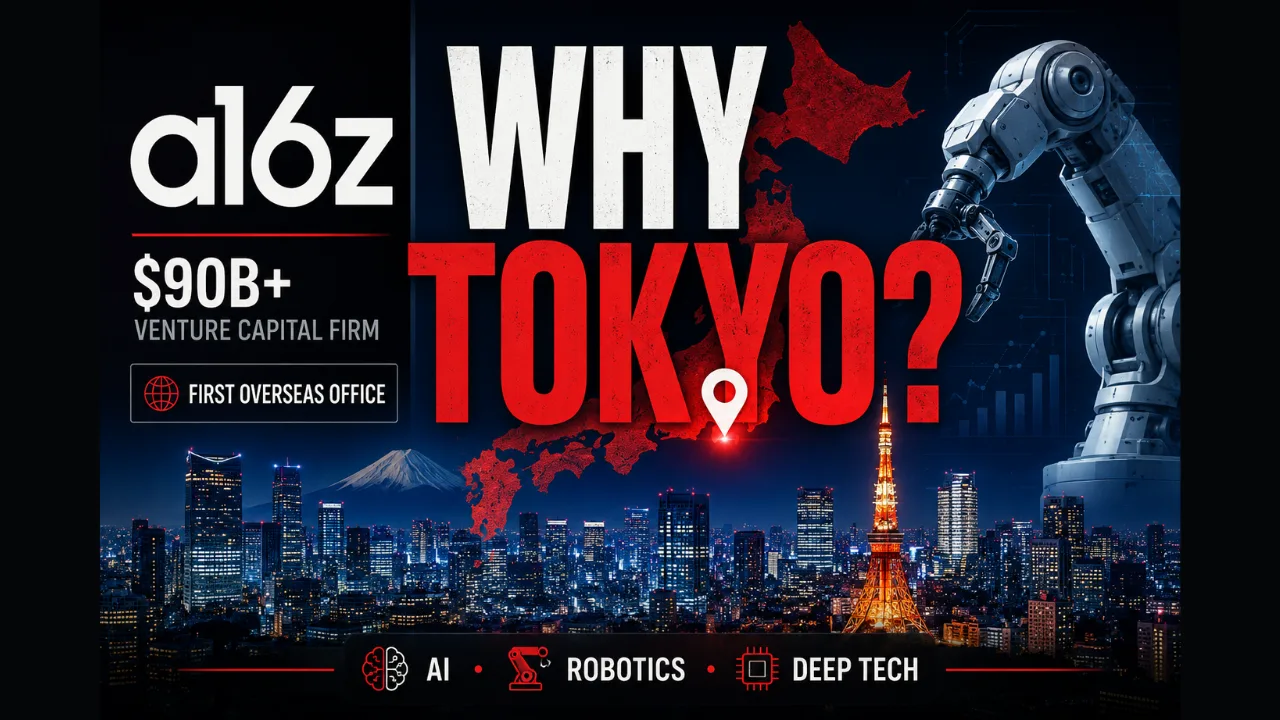
Andreessen Horowitz (a16z) manages more than $90 billion in assets.
Since its founding in 2009, the firm has become one of the most influential venture capital firms in the world, backing companies such as Facebook, Airbnb, Coinbase, GitHub, Lyft, Robinhood, and OpenAI.
Yet despite its global influence, a16z has never opened an office outside the United States.
Until now.
This summer, the firm's first overseas office will open in Tokyo.
Not London.
Not Singapore.
Not Dubai.
Tokyo.
Most coverage of this announcement has focused on the headline itself: a16z is expanding into Japan.
But the more interesting question is not where they are opening.
It is why.
And even more importantly, what this actually means for founders, investors, and startup ecosystems across Asia.
As someone who works closely with startup founders, investors, accelerators, and ecosystem partners across Japan, Korea, and Taiwan every week, I believe much of the discussion around this announcement is missing the bigger picture.
This is not simply an office opening.
It is a signal.
A signal about where one of the world's most influential venture firms believes future opportunities will emerge.
A signal about how Japan's startup ecosystem is evolving.
And perhaps most importantly, a signal about how Asia's relationship with global venture capital may change over the next decade.
Let's break down why Tokyo was chosen, what a16z is likely to do in Japan, what it means for founders across Asia, and the biggest risk that could prevent this move from reaching its full potential.
Why Tokyo Instead of Singapore, London, or Dubai?
This is the question almost everyone is asking.
And interestingly, it is also the question that has received the fewest serious answers.
a16z has never publicly said:
"We chose Tokyo over Singapore because of X."
So nobody can claim to know their exact reasoning.
However, if we look at the signals, several patterns emerge.
Japan May Be the Largest Untapped Opportunity Among Developed Economies
If a16z simply wanted an international office, there were easier choices.
London is one of the world's largest financial centers.
Singapore is already established as Southeast Asia's startup and investment hub.
Dubai has rapidly positioned itself as a gateway connecting Europe, Asia, and the Middle East.
Yet a16z skipped all three.
Why?
One possible explanation is that Japan represents something unique.
Japan is:
- The world's fourth-largest economy
- A global manufacturing leader
- A robotics powerhouse
- A semiconductor and industrial technology hub
- One of the largest enterprise software markets in Asia
Yet compared to Silicon Valley, many global investors still view Japan as underexplored.
In other words, the opportunity-to-competition ratio may be unusually attractive.
Many global investors are already heavily deployed in London and Singapore.
Japan, however, still feels under-owned.
For a firm that has built its reputation finding outsized opportunities before everyone else, that matters.
The Government Is Making One of the Largest Startup Bets in the World
Another major signal comes from government policy.
In 2022, Japan launched its Five-Year Startup Development Plan.
The targets are ambitious:
- ¥10 trillion in startup investment
- 100,000 startups
- 100 unicorn companies
This is one of the largest startup ecosystem initiatives ever undertaken by a developed economy.
Three years into the plan, progress is tangible.
Thousands of startups have been created.
New unicorns are emerging.
University entrepreneurship programs are expanding.
Government agencies are increasingly focused on startup growth.
Importantly, this is not just financial support.
It is a coordinated effort to reshape the country's innovation ecosystem.
For global investors, government commitment reduces uncertainty.
It creates long-term infrastructure.
It signals that startup development is becoming a national priority rather than a temporary trend.
This may explain why Ben Horowitz personally met with Japanese leadership before the office announcement.
This does not look like a routine market expansion.
It looks strategic.
The AI, Robotics, and Deep-Tech Thesis
This may be the most important reason of all.
Most discussions about AI focus on software.
But increasingly, the next wave of innovation may involve physical AI.
Robotics.
Autonomous systems.
Industrial automation.
Advanced manufacturing.
Semiconductors.
Defense technologies.
And few countries are better positioned in those areas than Japan.
Japan possesses decades of expertise in:
- Robotics
- Manufacturing
- Industrial systems
- Precision engineering
- Automation
These are sectors that become increasingly important as AI moves from digital experiences into physical environments.
At the same time, Japan approved its first national AI Basic Plan and has significantly increased support for AI development.
The overlap with a16z's investment thesis is hard to ignore.
If AI becomes embedded into factories, robots, logistics systems, defense infrastructure, and industrial workflows, Japan becomes strategically important.
Singapore is an excellent business hub.
But Japan is where many physical AI applications can actually be developed, tested, and deployed at scale.
Japan May Be Undervalued
Another theory investors frequently discuss is valuation.
The United States remains the center of venture capital.
But it is also one of the most competitive startup markets in the world.
Japan, meanwhile, often has:
- World-class engineers
- Deep technical talent
- Global industrial expertise
- Strong research institutions
Yet startup valuations frequently remain lower than comparable companies in Silicon Valley.
For investors, that combination is attractive.
It creates asymmetry.
The possibility of finding globally competitive companies before the broader market fully recognizes their value.
This is exactly the type of opportunity sophisticated venture firms look for.
They May Be Investing in Japan's Future, Not Its Present
Perhaps the most compelling explanation is that a16z is not betting on what Japan is today.
They are betting on what Japan could become over the next decade.
Great investors often focus on trajectories rather than current rankings.
Japan still faces challenges:
- Limited late-stage startup success stories
- Relatively low founder density compared to Silicon Valley
- Fewer globally dominant startups
But the direction is changing.
Government support is increasing.
More AI startups are emerging.
Universities are becoming more entrepreneurial.
Corporate innovation is improving.
Cross-border collaboration is growing.
More founders are building globally from day one.
From that perspective, Tokyo is not simply an office location.
It is a long-term strategic bet.
My interpretation is simple:
a16z did not choose Tokyo because it is the easiest place to invest in Asia.
They chose Tokyo because they may believe Japan is one of the most undervalued strategic technology ecosystems among developed economies.
What Will a16z Actually Do in Japan?
Many people assume this will be a small representative office.
That seems unlikely.
The signals suggest something much bigger.
The Speedrun Program May Matter More Than the Office
One of the most important announcements was that a16z intends to bring its Speedrun entrepreneur development program to Japan within the next several years.
This could become more impactful than the office itself.
Capital alone rarely transforms ecosystems.
Networks do.
Knowledge transfer does.
Founder education does.
A Tokyo-based Speedrun program would create a direct pipeline between Japan-based founders and Silicon Valley-level networks.
That infrastructure has historically been limited.
The result could be a new generation of founders with significantly stronger access to global investors, operators, and mentors.
They Are Not Coming to Write Small Checks
In early 2026, a16z announced approximately $15 billion across multiple new funds.
This is not a firm entering a market cautiously.
It is a firm with enormous resources.
Most likely, they will focus on:
- Series A
- Growth-stage companies
- Deep-tech startups
- AI infrastructure
- Enterprise software
- Robotics
- Semiconductors
- Defense technologies
The overlap between these sectors and Japan's strengths is substantial.
Companies such as Sakana AI, Preferred Networks, and EdgeCortix demonstrate the potential already exists.
The challenge is producing many more of them.
What This Does NOT Mean
Founders should avoid unrealistic expectations.
This does not mean:
- Every startup will suddenly get funded
- Pre-seed fundraising becomes easy
- Japan's startup ecosystem problems disappear overnight
If you are an early-stage founder, the ecosystem may improve.
But your next funding round still depends on execution.
The office changes the environment.
It does not eliminate the fundamentals.
What Changes for Founders Across Asia?
The first impact is psychological.
In venture capital, signals matter.
When one of the world's most influential firms enters a market, everyone pays attention.
Expect More Global Investors to Follow
History suggests that major investors often trigger second-order effects.
Other investors begin asking:
"What are they seeing that we are missing?"
As a result, we may see:
- More US VC activity in Japan
- More European investor interest
- More Japan-focused partnerships
- More cross-border investment programs
The impact of a16z may ultimately extend far beyond a16z itself.
The Micro-IPO Narrative Is Being Challenged
Japan has long struggled with what investors call the "micro-IPO problem."
Many startups list publicly at relatively small valuations.
Instead of becoming global category leaders, they optimize for early liquidity.
The result is often slower long-term growth.
a16z introduces an alternative path.
Instead of:
Build → IPO quickly
The narrative becomes:
Build → Raise growth capital → Expand globally → Consider larger exits later
That shift could prove transformative.
A Stronger Bridge Between Asia and Silicon Valley
One challenge I constantly observe is not technology.
It is translation.
Not language translation.
Business translation.
Japanese, Korean, and Taiwanese founders often build excellent products.
But many struggle to position themselves effectively for global investors.
Having global investors physically present in Tokyo can help narrow that gap.
Not eliminate it.
But reduce it.
That matters.
Especially for founders thinking globally from the beginning.
The Risk Nobody Wants to Talk About
Despite all the excitement, there is one issue that remains largely unresolved.
Japan's biggest problem may not be capital.
It may be circulation.
Capital Is Not the Bottleneck
Today, Japan has:
- Government funding
- Corporate venture capital
- University entrepreneurship programs
- International investors
- Growing startup support infrastructure
Money is increasingly available.
The challenge is what happens after funding.
The "Big in Japan" Problem
Many startups become successful domestically.
Few become globally dominant.
The issue is not founder quality.
In fact, many investors consistently praise Japanese founders for:
- Discipline
- Technical depth
- Long-term thinking
- Operational excellence
The issue is ambition and international scale.
Many startups optimize for Japan.
Few optimize for the world.
For a16z, this creates risk.
Their investment model depends on global outcomes.
If startups remain primarily domestic, the economics become harder to justify.
Validation Is Not Transformation
This may be the most important takeaway from the entire story.
a16z opening a Tokyo office is an extraordinary validation signal.
It confirms that global investors increasingly view Japan as strategically important.
But validation is not transformation.
One office does not create global champions.
One VC firm does not solve structural ecosystem challenges.
Transformation happens when founders decide to build globally competitive companies.
And that is where I am most optimistic.
Over the last few years, I have seen a noticeable shift.
More founders are building internationally from day one.
More startups are targeting global markets.
More teams are raising internationally.
More entrepreneurs are thinking beyond domestic success.
That change matters more than any single investor.
Final Thoughts
a16z opening its first overseas office in Tokyo is one of the most important startup ecosystem developments in Asia this decade.
Not because of the office itself.
But because of what it signals.
It signals confidence in Japan.
It signals confidence in AI, robotics, and deep technology.
It signals confidence in the next generation of Asian founders.
And perhaps most importantly, it signals that global venture capital increasingly sees Japan not as a local market, but as a strategic innovation platform.
The opportunity now belongs to founders.
Because a16z's arrival does not guarantee outcomes.
It simply expands possibilities.
The startups that benefit most will not necessarily be the ones that raise money.
They will be the founders who use this moment to build globally ambitious companies.
In the end, that is what will determine whether this becomes a historic turning point or simply another office opening.
The signal has been sent.
Now the ecosystem has to respond.