The 2026 Startup Rankings Just Dropped. The Most Shocking Story? Asia Is Not Capturing Enough of the Recovery.
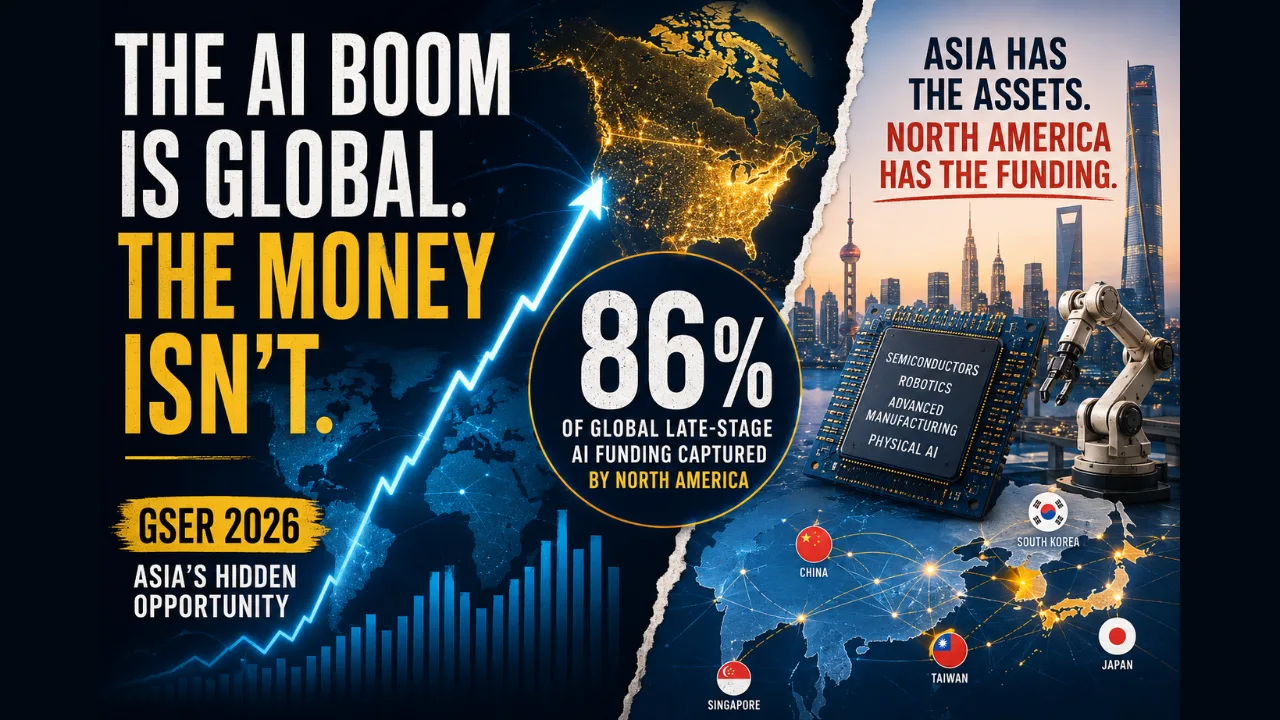
The latest Global Startup Ecosystem Report (GSER) 2026 from Startup Genome has been released.
You can access the full report here.
Like every year, most discussions will focus on rankings.
Which ecosystem moved up?
Which city fell?
Who entered the Top 10?
After reading the report, I believe the rankings themselves are not the most interesting story.
The real story is hidden in the data.
The global startup economy is recovering.
AI is creating unprecedented amounts of value.
Yet much of that value is flowing into a surprisingly small number of ecosystems.
And while Asia possesses many of the assets powering the future of AI, it is capturing far less of the current recovery than many might expect.
The report reveals three powerful trends:
The startup recovery is real.
The gains are becoming increasingly concentrated.
Asia may be uniquely positioned for the next AI wave if it can capture more value from its strengths.
Let's start with the numbers.
Part 1: The Startup Recovery Is Real
Silicon Valley Captured Nearly 40% of Global Startup Value Growth
The global startup economy added approximately $2.8 trillion in ecosystem value.
One ecosystem alone contributed approximately $1.1 trillion of that growth.
Silicon Valley.
That means nearly 40% of all startup ecosystem value growth came from a single ecosystem.
For years, people have predicted that innovation would become increasingly distributed across the world.
The latest data suggests the opposite.
Silicon Valley remains the center of gravity for venture-backed innovation.
And its lead may actually be widening.
Three Ecosystems Captured Most of the World's Growth
The concentration becomes even more remarkable when looking beyond Silicon Valley.
Just three ecosystems:
Silicon Valley
New York City
Los Angeles
captured roughly two-thirds of all global startup ecosystem value growth.
Thousands of startup ecosystems exist around the world.
Yet most of the gains are being captured by only a handful.
The startup economy increasingly resembles a winner-takes-most market.
AI-Native Startup Value Grew 969%
This may be the most shocking statistic in the entire report.
Since GSER 2021:
AI-Native startup value increased 969%
Non-AI startup value increased 101%
AI startups are creating value at nearly ten times the pace of the broader startup ecosystem.
This is not simply another technology trend.
It is fundamentally reshaping where talent, capital, and attention are flowing.
AI Captured More Than Half of Global Late-Stage Funding
For the first time, AI-Native startups accounted for more than half of all global late-stage venture funding.
AI is no longer competing with other sectors.
In many ways, it has become the dominant destination for growth capital.
The biggest venture bets globally are increasingly AI bets.
North America Captured 86% of Global Late-Stage AI Funding
This may be the most important AI statistic in GSER 2026.
While AI is a global phenomenon, the overwhelming majority of investment value is flowing into North America.
North America captured 86% of global late-stage AI funding.
Not 60%.
Not 70%.
Eighty-six percent.
The AI boom is global.
The rewards are not.
The Recovery Is Real But Not Equal
One of the clearest messages from the report is that startup ecosystems are not recovering equally.
The startup economy is growing again.
But most of the gains are flowing toward ecosystems that already possess:
Strong venture infrastructure
Global networks
AI leadership
Deep capital pools
Established founder ecosystems
Recovery is happening.
But it is highly uneven.
The Gap Between Winners and Everyone Else Is Growing
Perhaps the most concerning trend is that startup ecosystems are not converging.
They are diverging.
The strongest ecosystems continue attracting more capital, more founders, more talent, and more attention.
The rich are getting richer.
Part 2: Asia Is Not Capturing Enough of the Recovery
This is where the report becomes especially interesting.
Because Asia is not lacking innovation.
If anything, Asia possesses many of the assets required to power the next generation of technological breakthroughs.
Yet much of the startup value and AI investment generated by the current recovery is flowing elsewhere.
China: Still a Global Startup Powerhouse
Despite geopolitical tensions, regulatory pressure, and economic headwinds, Beijing and Shanghai remain among the world's strongest startup ecosystems.
Many expected a more significant decline.
Instead, both ecosystems continue ranking among the global leaders.
China's startup engine remains remarkably resilient.
Taiwan Entered the Global Top 40 for the First Time
One of the most notable developments in Asia was Taiwan entering the Global Top 40 Emerging Startup Ecosystems for the first time.
This is not simply a startup story.
It is a semiconductor story.
It is an AI infrastructure story.
As AI becomes increasingly dependent on chips, compute power, and advanced manufacturing, Taiwan's strategic importance continues to rise.
The rankings are beginning to reflect that shift.
Singapore Continues to Punch Above Its Weight
Singapore remains one of the world's most impressive startup ecosystems.
With a population of only around six million people, it consistently competes against ecosystems representing countries many times larger.
Singapore proves that ecosystem quality often matters more than ecosystem size.
Its ability to attract founders, investors, multinational corporations, and regional headquarters remains exceptional.
South Korea: One of Asia's Biggest Contradictions
South Korea may be one of the most overlooked stories in the report.
Seoul ranks #11 globally.
That sounds impressive.
Until you consider Korea's assets.
South Korea is home to world-leading semiconductor companies, advanced manufacturers, consumer technology giants, engineering talent, and digital infrastructure.
It consistently ranks among the world's leaders in R&D spending.
On paper, Korea should be exceptionally well-positioned for the AI era.
Yet it has not translated those strengths into startup ecosystem dominance to the same extent as Silicon Valley.
Its challenge may not be creating technology.
It may be converting technological leadership into more venture-scale outcomes.
Japan: The World's Largest Undervalued Startup Opportunity?
Japan may be the most fascinating ecosystem in the report.
Tokyo ranks #12 globally.
For many countries, that would be an extraordinary achievement.
For the world's third-largest economy, it raises questions.
Japan remains a global leader in:
Robotics
Manufacturing
Industrial systems
Healthcare technology
Precision engineering
Advanced research
Yet its startup ecosystem has historically underperformed relative to those strengths.
Recent developments suggest this may be changing.
Japan's ¥10 trillion startup initiative.
Growing international investor interest.
Andreessen Horowitz selecting Tokyo for its first overseas office.
All point toward increasing confidence in Japan's startup future.
The question is no longer whether Japan has the assets.
The question is whether it can convert those assets into venture-scale companies fast enough to capture the next wave of innovation.
Part 3: Asia Has Many of the Assets, But Not Enough of the Value
This may be the most important insight hidden inside GSER 2026.
Asia possesses many of the assets powering the future of AI.
Taiwan sits at the center of the semiconductor supply chain.
South Korea is a global leader in chips, electronics, and advanced manufacturing.
Japan leads in robotics, industrial automation, and precision engineering.
China continues investing heavily across AI, robotics, industrial systems, and deep technology.
Yet the majority of AI investment value is flowing elsewhere.
North America captured 86% of global late-stage AI funding.
Silicon Valley alone captured nearly 40% of global startup ecosystem value growth.
In other words:
Many of the physical foundations of the AI economy are located in Asia.
Much of the financial upside is currently being captured elsewhere.
This creates one of the most important questions of the next decade:
Can Asia capture more of the value generated by its own strengths?
Part 4: The Next AI Wave May Favor Asia
Much of today's AI conversation revolves around:
Foundation models
Software applications
Agents
Productivity tools
This helps explain why Silicon Valley and North America dominate today's AI investment landscape.
But the next wave of AI may look very different.
Increasingly, AI is moving into the physical world.
Robotics
Physical AI
Autonomous systems
Industrial automation
Smart factories
Advanced manufacturing
Semiconductor infrastructure
These happen to be areas where Asia possesses significant advantages.
The rise of AI is increasing the strategic importance of semiconductor and hardware ecosystems.
And that creates new opportunities for places like:
🇹🇼 Taiwan
🇰🇷 South Korea
🇯🇵 Japan
🇨🇳 China
Several Asian ecosystems are already outperforming their economic size.
Others are underperforming relative to their industrial strength.
The next decade may determine which of them successfully convert their technological advantages into startup ecosystem leadership.
The Most Important Insight
After reviewing GSER 2026, one conclusion stands out.
Asia's biggest startup opportunity may not be creating more startups.
It may be converting existing strengths into venture-scale companies.
The region already possesses:
World-class semiconductors
World-class manufacturing
World-class robotics
World-class engineering talent
World-class research institutions
The challenge is not invention.
The challenge is commercialization.
How do you convert:
Research into products
Engineering talent into venture-scale companies
Manufacturing advantages into startup advantages
Deep-tech capabilities into global category leaders
Today, North America dominates AI software funding.
Tomorrow, Asia may be uniquely positioned to benefit from the rise of robotics, physical AI, advanced manufacturing, and semiconductor infrastructure.
The most important startup story in Asia may not be who is winning today.
It may be which ecosystems successfully bridge deep-tech strengths into globally scalable venture-backed growth.
If that happens, the startup rankings of 2030 could look very different from the startup rankings of 2026.
The question isn't whether Asia has the assets to lead the next innovation wave.
The question is whether it can capture the value this time.