Cross-Border Fundraising: What APAC Founders Need to Know About Raising from Global VCs
Most startup fundraising advice is written from Silicon Valley.
Most founders building outside Silicon Valley face a very different reality.
They are often building in Japan, Korea, Singapore, Taiwan, Southeast Asia, Turkey, Australia, or emerging startup ecosystems. They may have strong products, early customers, domain expertise, and even revenue.
Yet many still struggle to raise from global investors.
Why?
That was the central topic of our recent discussion:
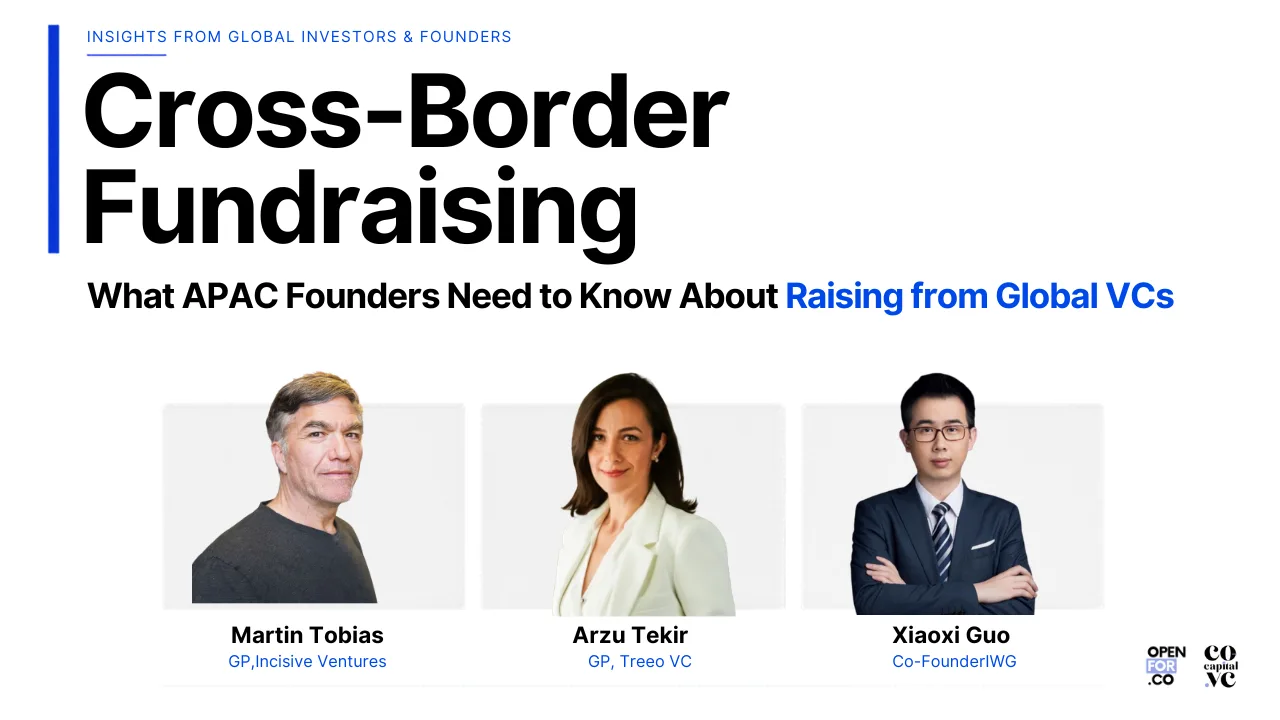
Cross-Border Fundraising: How APAC Startups Raise from Global VCs
The panel hosted by openfor.co and co-capital brought together investors and founders who have worked across multiple geographies and have seen firsthand what separates companies that successfully attract international investors from those that do not.
Featured speakers included:
- Martin Tobias, Managing Partner at Incisive Ventures
- Arzu Tekir, General Partner at Treeo VC
- Xiaoxi Guo, Co-Founder of IWG
Moderated by Erdinc Ekinci and Yu Li Shein
The conversation uncovered several themes that appeared repeatedly throughout the discussion.
Interestingly, very little of it was actually about fundraising.
Most of it was about trust, distribution, positioning, relationships, and market access.
And that may be the most important lesson of all.
The Biggest Myth About Fundraising
Many founders assume fundraising starts when they decide they need capital.
Investors see it very differently.
Fundraising often begins months or years before a founder sends their first pitch deck.
By the time investors receive a deck, they are already evaluating:
- Founder credibility
- Industry expertise
- Distribution advantage
- Market understanding
- Team dynamics
- Digital footprint
- Existing traction
- Ecosystem signals
In other words:
Investors are rarely evaluating an idea.
They are evaluating the probability of execution.
The question is not:
"Is this startup interesting?"
The question is:
"Can this team realistically build a large company?"
That distinction changes everything.
Product Is No Longer the Main Differentiator
One of the strongest themes throughout the discussion was how AI is changing startup creation.
Historically, building software was difficult.
Companies needed:
- Engineers
- Infrastructure
- Capital
- Long development cycles
Today?
A founder can build an MVP in days.
AI dramatically reduces technical barriers.
As Martin Tobias explained:
"The bottleneck is no longer software development. The bottleneck is distribution."
Anyone can build.
Far fewer people can consistently acquire customers.
This is becoming one of the most important fundraising filters.
Investors increasingly ask:
- How will you get customers?
- Why are you uniquely positioned?
- What distribution advantage do you have?
- Why can't competitors copy this?
A startup without a clear distribution strategy may struggle to raise even if the product is technically impressive.
Domain Expertise Still Wins
Many people believe AI makes industry expertise less important.
The panel strongly disagreed.
Arzu Tekir emphasized that domain expertise is becoming more valuable, not less.
Why?
Because AI can help build solutions.
It cannot automatically identify meaningful problems.
The strongest founders often have:
- Deep industry experience
- Existing customer relationships
- Strong understanding of workflow pain points
- Credibility inside their market
One example shared during the discussion involved a founder who spent years working in supply chain operations.
He had already experienced the problem himself.
He had tried existing solutions.
He knew why they failed.
And perhaps most importantly:
He already knew hundreds of potential customers.
That level of insight creates a significant advantage.
Investors notice it immediately.
Investors Are Funding Distribution, Not Just Technology
A recurring question investors ask is:
"How will your first customers find you?"
The answer matters more than many founders realize.
Martin described a founder who convinced him largely because he already had access to his target audience through an industry community he had built over several years.
Not because the technology was extraordinary.
Not because the pitch deck was beautiful.
Because customer acquisition was already visible.
Many founders focus heavily on product development while treating distribution as something to solve later.
Increasingly, investors see that as a major risk.
The best founders think about:
- Customer acquisition
- Market access
- Strategic partnerships
- Community
- Network effects
from the beginning.
Why Many APAC Founders Struggle to Raise from US Investors
This was one of the most important discussions.
Many founders assume that having a great product is enough.
Unfortunately, that is rarely true.
Arzu shared a common pattern she repeatedly sees:
Founders build strong products outside the United States but struggle to raise capital from American investors.
The issue is often not the product.
It is market understanding.
US investors frequently ask:
- Can this company win in the US market?
- Does the founder understand American customers?
- Can they recruit US talent?
- Can they build partnerships in the US?
- Can they sell effectively there?
For many investors, the biggest concern is not technology.
It is execution inside the target market.
Do Founders Need To Move To The United States?
The answer was nuanced.
Not necessarily.
Several examples were discussed where founders validated products and built traction in their home countries before expanding internationally.
In fact, many successful startups first prove:
- Product-market fit
- Customer demand
- Pricing
- Sales process
inside their domestic market.
Only later do they expand.
However, a key pattern emerged:
When the United States becomes the primary growth market, founders often establish a meaningful presence there.
Examples included founders who:
- Built initial traction in Australia
- Built initial traction in Spain
- Validated products locally
and then relocated part of the leadership team to the United States.
Investors viewed this positively because it demonstrated commitment to market expansion.
The lesson is simple:
You do not necessarily need to start in the United States.
But if the US becomes your largest opportunity, eventually you may need meaningful presence there.
Why Founder Relationships Matter More Than Pitch Decks
One surprising topic was cold outreach.
Founders often ask:
"Can I cold email investors?"
The answer was yes.
But with an important caveat.
Cold outreach is rarely the best approach.
The panel repeatedly emphasized:
Relationships compound.
Investors are more likely to respond when:
- They know you
- Someone they trust introduces you
- They have seen your work before
- Your name appears repeatedly within their network
Fundraising is often easier when investors have heard about you long before the fundraising process begins.
This is one reason accelerator programs, startup communities, and ecosystem participation remain so important.
They create trust before the fundraising conversation starts.
Your Digital Footprint Is Becoming Your First Pitch
One of the strongest fundraising insights from Arzu was this:
Before investors respond, many will Google you.
They will examine:
- Personal website
- Content
- Previous work
- Industry reputation
In many cases, your online presence influences whether the investor even takes the meeting.
This means:
Your digital footprint is no longer optional.
It is part of due diligence.
Founders who consistently share:
- Industry insights
- Progress updates
- Thought leadership
- Product developments
often create stronger investor confidence before the first conversation.
Many founders underestimate how important this has become.
Stop Pitching Every Investor
This may be one of the most expensive fundraising mistakes.
Many founders create a list of hundreds of investors and start sending identical messages.
The panel strongly advised against this.
Not all investors are relevant.
Investors have different:
- Stages
- Check sizes
- Geographies
- Sectors
- Investment theses
A healthcare investor is different from a B2B SaaS investor.
A seed investor is different from a Series A investor.
A Japan-focused fund is different from a US expansion fund.
The best founders spend significant time researching investors before reaching out.
The goal is not maximum outreach.
The goal is maximum relevance.
One of the Most Overlooked Fundraising Skills: Knowing When To Walk Away
This was one of the most valuable founder perspectives shared by Xiaoxi Guo.
Founders often assume:
More investor meetings = progress.
That is not always true.
Some investors may repeatedly ask for information without genuine investment intent.
Some funds may not currently have capital available.
Some opportunities simply are not a fit.
Learning when to walk away saves enormous amounts of time and energy.
Fundraising is not about convincing everyone.
It is about finding aligned partners.
Investors become long-term stakeholders.
Founders should evaluate investors as carefully as investors evaluate founders.
The Real Fundraising Funnel
Many founders imagine fundraising as:
Pitch → Meeting → Investment
Reality is very different.
The actual process often looks like:
Visibility → Relationships → Credibility → Traction → Introductions → Investor Interest → Due Diligence → Investment
Notice something important.
Fundraising is near the end.
Not the beginning.
Most successful fundraising outcomes happen because founders spent months or years building signals before they ever raised capital.
Final Thoughts
Perhaps the biggest lesson from the discussion is that global fundraising is not primarily a fundraising problem.
It is a trust problem.
A visibility problem.
A credibility problem.
A distribution problem.
A relationship problem.
Investors want to reduce uncertainty.
The founders who successfully raise internationally are often the ones who make themselves easier to understand, easier to trust, and easier to introduce.
The companies that attract global investors are rarely discovered by accident.
They consistently build signals.
They build relationships.
They build traction.
And eventually, the capital follows.
If you're an APAC founder hoping to raise from global investors, focus less on fundraising and more on becoming investable.
That shift alone may change everything